How to Start Learning Guitar: A Beginner's Guide to the First Steps

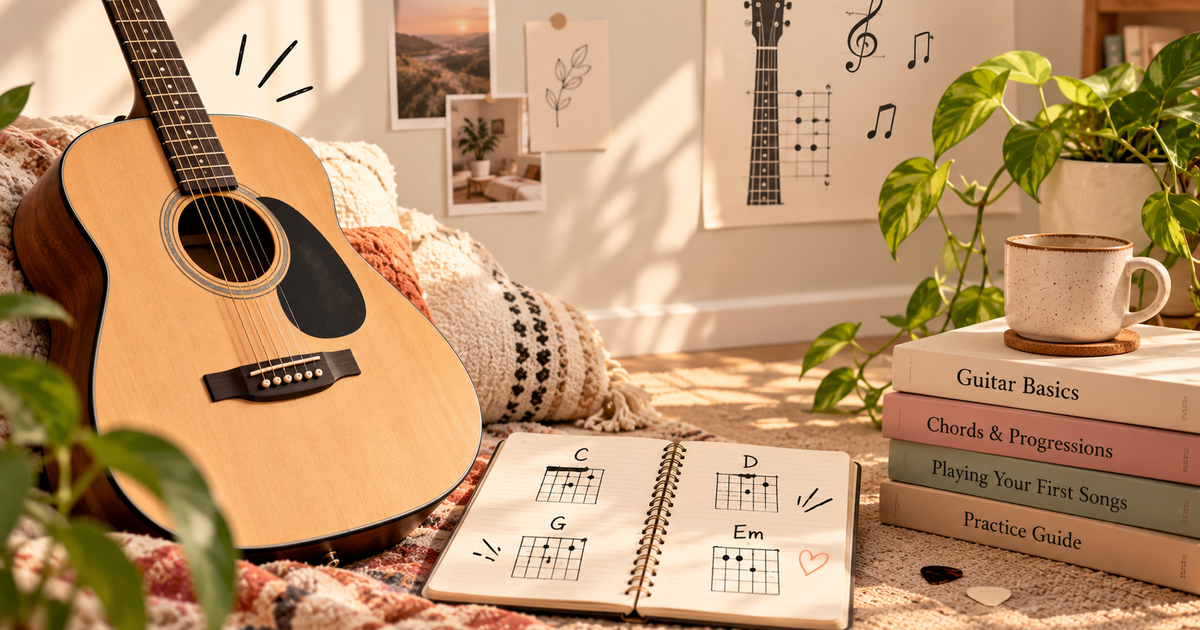
How long does it take to learn guitar? There is no fixed number of weeks or months that applies to everyone. A complete beginner may learn basic chords and simple songs relatively early, while developing confident rhythm, chord changes, fingerstyle, improvisation or advanced technique takes considerably longer.
The biggest factors are what you want to play, how consistently you practise, how you practise and whether you receive useful feedback.
How Long Does It Take to Learn Guitar as a Beginner ?
| Approximate stage | What you may be working on |
|---|---|
| First few weeks | Guitar basics, posture, picking, simple chords |
| 1–3 months | Basic chord changes, rhythm patterns and easier songs |
| 3–6 months | Smoother transitions, more songs, improved timing |
| 6–12 months | Broader chord vocabulary, stronger rhythm and more independent playing |
| Beyond 1 year | More advanced techniques, repertoire and personal style |
A realistic way to think about guitar progress is through milestones rather than a deadline.
These are general learning stages, not guarantees. Someone practising consistently with focused guidance may progress differently from someone practising irregularly or spending most of their time repeating songs they already know.
What Can You Learn in Your First Few Weeks?
Your first goal should not be to become an expert guitarist.
Instead, you can focus on understanding:
- Guitar parts and tuning
- Correct sitting and hand position
- How to hold a pick
- Basic picking patterns
- Open chords
- Simple rhythm patterns
- How chord diagrams work
- Basic song structure
At this stage, even switching between a few chords can feel difficult. Your fingers are developing new coordination and muscle memory.
That is normal.
How Long Does It Take to Learn Guitar Chords?
Basic open chords can often be introduced early in a beginner's learning journey, but knowing a chord and changing between chords smoothly are different skills.
A beginner might memorise several chord shapes but still struggle to:
- Change quickly
- Keep the rhythm going
- Avoid accidentally muting strings
- Press every note cleanly
- Maintain a steady tempo
This is why practising chord transitions is often more useful than simply memorising a larger list of chords.
Start with a small group of common chords and practise moving between them slowly and accurately.
Speed can come later.
How Much Should You Practise Guitar?
You do not need to spend several hours every day to make progress.
For many beginners, a short, consistent practice routine is easier to maintain than occasional marathon sessions.
A practice session could include:
5 minutes: tuning and warm-up10 minutes: chord changes10 minutes: rhythm or picking10–15 minutes: working on a song5 minutes: reviewing difficult sections
The exact duration can change according to your schedule.
What matters is that practice has a purpose.
Playing the same song repeatedly from beginning to end is not always the most effective way to improve. If one chord transition keeps breaking down, isolate that transition and practise it slowly.
Why Does Guitar Progress Sometimes Feel Slow?
This is one of the most frustrating parts of learning guitar.
You may practise consistently and still have days when your playing feels worse.
That does not necessarily mean you are losing progress.
Coordination develops gradually, and different skills improve at different rates. A chord that felt impossible one week can suddenly become easier after enough repetition.
Beginners on Reddit frequently describe this uneven feeling of progress. Discussions around learning guitar often focus on daily practice, muscle memory, learning songs and giving skills enough time to develop rather than expecting a fixed improvement every day.
How Long Does It Take to Play a Full Song?
This depends heavily on the song.
A simple song built around a few repeated chords may be approachable relatively early. A song with complex chord changes, fingerstyle, barre chords, fast picking or intricate rhythm will require more preparation.
Instead of asking:
"How many months before I can play a song?"
ask:
"What skills does this song require?"
For example, if a song contains four basic chords and a repetitive strumming pattern, a beginner may be able to work toward it early.
If it includes difficult barre chords and fast rhythmic changes, you may need to build those skills first.
How Long Does It Take to Learn Guitar by Yourself?
You can absolutely begin guitar independently using books, videos, chord diagrams and online lessons.
Self-learning works particularly well for learners who are comfortable creating their own practice schedule.
The challenge is knowing whether you are practising correctly.
A teacher can help with:
- Hand position
- Chord fingering
- Picking technique
- Rhythm
- Posture
- Practice structure
- Choosing suitable songs
- Correcting inefficient habits
That feedback can prevent you from spending weeks reinforcing the same mistake.
Is Guitar Harder Than Piano?
There is no universal answer.
The instruments challenge different skills.
Guitar requires you to coordinate fretting and picking hands, learn chord shapes and develop rhythm. Piano requires coordination between the hands, finger independence, reading and control of different notes across the keyboard.
Whether one feels easier depends on the learner's musical background, goals and physical familiarity with the instrument.
Interestingly, people who already play another instrument may find some aspects of guitar easier because they already understand rhythm, musical structure or basic theory.
Acoustic vs Electric Guitar: Does the Learning Timeline Change?
The fundamentals overlap, but the playing experience is different.
Acoustic guitar can be a practical way to learn chords, rhythm and accompaniment.
Electric guitar opens the door to techniques and styles such as:
- Lead playing
- Bending
- Slides
- Riffs
- Distortion-based playing
- Rock and metal techniques
If your goal is electric guitar, you do not necessarily have to master acoustic guitar first. It makes more sense to choose the instrument and style that match what you actually want to play.
What Should a Beginner Learn First on Guitar?
A sensible progression is:
- Learn how the guitar is tuned.
- Develop correct posture and hand position.
- Learn basic picking and strumming.
- Learn a few common open chords.
- Practise switching between them.
- Build a steady rhythm.
- Learn simple songs.
- Introduce scales and basic music theory.
- Gradually develop barre chords and other techniques.
- Move toward the style and repertoire you enjoy.
You do not need to master every guitar technique before playing music.
In fact, learning simple songs alongside technical practice can make the process more enjoyable and give you a practical reason to keep practising.
What Is the Best Way to Measure Guitar Progress?
Don't measure progress only by the number of songs you know.
Look at skills such as:
- Can you tune your guitar?
- Can you hold chords cleanly?
- Can you switch between chords without stopping?
- Can you maintain a steady rhythm?
- Can you play along with a metronome?
- Can you learn a song without relying entirely on a tutorial?
- Can you recognise basic chord patterns?
- Can you correct your own mistakes?
These are stronger indicators of developing guitar ability.
Frequently Asked Questions
Learn Guitar With a Structured Progression
Learning guitar is not about reaching a finish line after a certain number of months. It is about gradually building coordination, rhythm, technique, musical understanding and repertoire.
If you want individual guidance rather than trying to piece everything together yourself, ChordsCraft's Acoustic Guitar Lessons provide live 1-on-1 instruction from beginner through advanced levels, including chords, fingerstyle, Bollywood and popular music, with options for structured learning and certification preparation.
ChordsCraft Music Editorial Team
Start Your Musical Journey Today
Experience 1-on-1 personalized lessons with certified music and dance instructors. Pick your instrument, choose your schedule, and get structured guidance.
Recommended Reading
 🥳Celebrations
Navratri 2026: Best Garba Songs, Bollywood Hits & Songs to Play on Guitar
Get ready for Navratri 2026 with the best Garba songs, energetic Bollywood hits and festive favourites. Discover music for Garba nights, Dandiya celebrations and beginner-friendly guitar performances.
 🎸Guitar
Easiest Chords to Learn on Guitar: A Beginner’s Guide
Just starting guitar? Learn the easiest guitar chords for beginners and start playing songs sooner. Explore essential open chords, simple chord changes, practice tips and beginner friendly progressions to help you build a strong foundation.

 General
Top 10 Arijit Singh Songs, Ranked (Updated August 2026)
Arijit Singh's 10 biggest songs, ranked by real Spotify data and cultural impact -updated after his 2026 retirement from playback singing.