
How to Overcome Stage Fear While Performing Music: Practical Ways to Build Performance Confidence

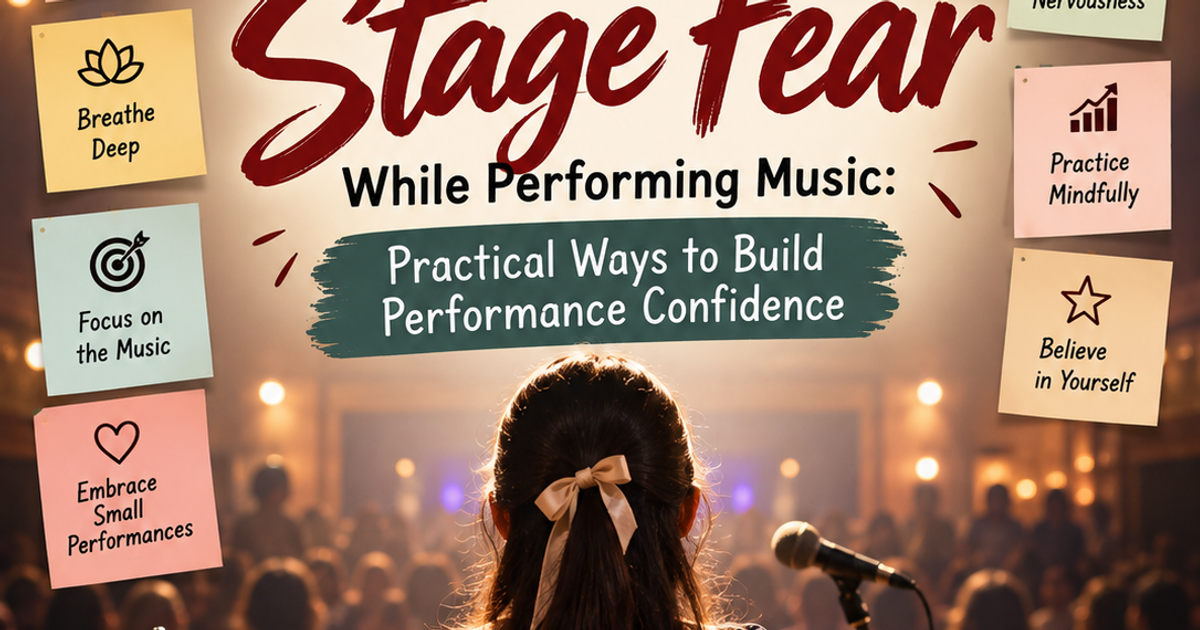
You know the feeling: you’ve practised the song dozens of times, but the moment your name is announced, your heartbeat suddenly gets louder than the music.
Stage fear is common among musicians, singers and performers. It can cause shaky hands, dry mouth, racing thoughts, muscle tension, breathing changes and even temporary memory lapses. The good news is that becoming a confident performer doesn't mean becoming completely fearless. It means learning how to perform despite the nerves.
What Is Stage Fear in Music?
Stage fear, also called stage fright or music performance anxiety, is the physical and mental response that can occur when performing in front of an audience.
A little nervousness isn't necessarily bad. It can increase energy and concentration. The problem begins when those feelings become strong enough to affect your timing, memory, coordination, breathing or musical expression.
For example, a pianist who plays perfectly during practice may suddenly lose their place during a recital. A singer may experience shaky breathing despite knowing the song thoroughly. These moments don't mean you aren't prepared, they mean you need to learn performance skills alongside musical skills.
Common Stage Fright Symptoms
Musicians may experience:
- Rapid heartbeat
- Shaky hands or legs
- Dry mouth
- Sweaty palms
- Tight muscles
- Short or shallow breathing
- Racing thoughts
- Fear of making mistakes
- Difficulty concentrating
- Temporary memory lapses
Why Do Musicians Get Stage Fright?
One major reason is the fear of being judged. When you're performing, it's easy to imagine that every missed note will be noticed.
Usually, that's not how audiences listen.
Most people experience the performance as a whole rather than analysing every individual note. A small mistake followed by a confident recovery can be virtually invisible to an audience.
Perfectionism Can Make Stage Fear Worse
Trying to perform every note perfectly can create unnecessary pressure. Instead of thinking, “I cannot make a mistake,” shift your focus towards musical expression, communication and recovery.
A performance isn't an examination of whether you're human. It's an opportunity to share music.
How Can You Overcome Stage Fear?
There isn't one magic trick for eliminating stage fright. The most effective approach is to combine preparation, performance practice and mental techniques.
1. Prepare Beyond Memorisation
Knowing the notes isn't always enough. Your preparation should include performing the piece under slightly unpredictable conditions.
Try:
- Starting from different sections
- Practising slowly with a metronome
- Playing without stopping after a mistake
- Recording yourself
- Performing while someone else is listening
- Practising without immediately looking at your music
The goal is to make your performance more resilient.
If you're building a regular practice habit, our guide to effective music practice can complement this approach and help you structure your sessions.
2. Practise Performing, Not Just Practising
This is one of the biggest differences between learning music and learning to perform.
Once or twice a week, create a mini performance at home. Stand or sit exactly as you would during the real event. Introduce your piece, perform it from beginning to end, and don't restart if you make a mistake.
You can gradually progress from:
Yourself → phone camera → family → friends → small audience → live performance
Repeated exposure makes performing feel familiar rather than unfamiliar.
3. Use Breathing to Manage Pre-Performance Nerves
When you're nervous, your breathing can become faster and shallower. For singers and wind-instrument players especially, this can make performing feel even harder.
Before going on stage, try a simple controlled-breathing routine:
Inhale for 4 seconds → hold for 4 → exhale for 6.
Repeat several times without forcing the breath.
The aim isn't to make yourself completely relaxed. It's to create enough physical control to think clearly and begin performing steadily.
4. Try Positive Self-Talk
Your internal dialogue matters.
Instead of:
“I'm going to forget everything.”
Try:
“I've prepared for this.”“I know the opening.”“One phrase at a time.”“If I make a mistake, I'll keep going.”
These statements don't guarantee a perfect performance. They simply prevent one nervous thought from becoming a chain reaction.
5. Visualise the Performance
Before a recital or concert, spend a few minutes imagining the actual experience.
Picture yourself:
- Walking onto the stage
- Setting up comfortably
- Taking your first breath
- Playing or singing the opening phrase
- Continuing through a difficult section
- Recovering calmly from a mistake
- Finishing the performance
The important part is to visualise the entire process, rather than only imagining applause at the end.
6. Stop Treating Mistakes Like Disasters
This might be the most important lesson for a beginner.
You will make mistakes.
Experienced musicians make them too.
What separates a confident performer from an anxious one is often the ability to continue after something goes wrong.
If you miss a note on piano, lose a chord on guitar or slightly miss a vocal entrance, don't stop and apologise. Stay with the rhythm and find your way back into the music.
The audience may remember the confidence of your recovery more than the mistake itself.
Build Confidence Through Small Performances
If your only performance is the annual school concert, stage fear can feel enormous.
Instead, create smaller opportunities:
- Perform for family
- Record yourself
- Join a music class recital
- Play for a friend
- Participate in a school or community event
- Perform one song at a time
This gradual exposure helps turn “I have to perform” into “I've done this before.”
At ChordsCraft Institute of Music, performance development can be part of structured music learning alongside technical training. The school's piano and acoustic guitar programmes include performance opportunities such as student recitals, YouTube showcases and studio recordings.
Create a Pre-Performance Routine
A predictable routine can help you feel more in control before walking onto a stage.
Try this:
10 minutes before: Stop intensive practice.7 minutes before: Light physical or instrumental warm-up.5 minutes before: Controlled breathing.3 minutes before: Visualise the opening.1 minute before: Relax your shoulders and focus on the first musical phrase.
Avoid trying to learn an entire difficult passage at the last second. Last-minute panic rarely improves performance.
What Should Musicians Focus on During a Performance?
Don't spend the entire performance thinking:
“Am I making a mistake?”
Instead, focus on:
- The rhythm
- The next phrase
- Your breathing
- Your tone
- Musical expression
- Communication with the audience
For guitarists, that might mean staying connected to the chord progression. For pianists, it could mean focusing on phrasing and hand coordination. For singers, it may mean maintaining breath support and communicating the emotion of the song.
That shift from self-monitoring to musical communication can make performing feel much more natural.
How Long Does It Take to Overcome Stage Fear?
There is no fixed timeline.
Some musicians notice a difference after a few performances. Others need months of gradual exposure before performing feels comfortable.
The objective isn't to reach a point where you never feel nervous.
The objective is to become capable of performing well while nervous.
That is what real performance confidence looks like.
Frequently Asked Questions
Turn Practice Into Performance
Learning an instrument is only part of becoming a musician. Learning how to perform, recover from mistakes and communicate confidently is another skill altogether.
If you want to develop your technique alongside performance confidence, ChordsCraft offers 1-on-1 online music lessons across piano, acoustic guitar, vocals and other disciplines, with structured learning paths and performance opportunities.
Do not forget to explore the piano and acoustic guitar courses or book a free trial class to experience the teaching approach before enrolling.
Because the goal isn't to walk onto the stage without nerves.
It's to walk onto the stage, feel the nerves, take a breath and play anyway.

Debojoti De is a pianist, music educator, and the founder of ChordsCraft Institute of Music. He has been playing the piano for over 10 years and has taught 100+ students through personalized online lessons. His expertise includes beginner piano education, music theory, keyboard selection, and exam preparation for internationally recognized curricula such as Trinity and ABRSM. As one of the Top 5 Indian Piano Teachers on Superprof, Debojoti combines practical teaching experience with in-depth research to create trusted buying guides, piano tutorials, and educational resources. Through his articles, he helps aspiring musicians choose the right instruments, develop effective practice habits, and build a strong musical foundation.
Start Your Musical Journey Today
Experience 1-on-1 personalized lessons with certified music and dance instructors. Pick your instrument, choose your schedule, and get structured guidance.
Recommended Reading
 General
Best Online Music Learning Classes: How to Choose the Right One
Looking for the best online music learning classes? From singing and instruments, learn what to look for in online music lessons including live 1 to 1 teaching, flexible schedules, trial classes, structured courses & personalised feedback.
 General
10 Greatest Female Singers of All Time: Iconic Voices That Changed Music
From breathtaking vocals to unforgettable performances, these 10 greatest female singers of all time have shaped generations of music. Discover the unique styles and lasting influence of legendary singers from India and around the world.
 General
Top 10 Arijit Singh Songs, Ranked (Updated August 2026)
Arijit Singh's 10 biggest songs, ranked by real Spotify data and cultural impact -updated after his 2026 retirement from playback singing.