How to Learn Singing at Home: A Beginner's Step-by-Step Guide

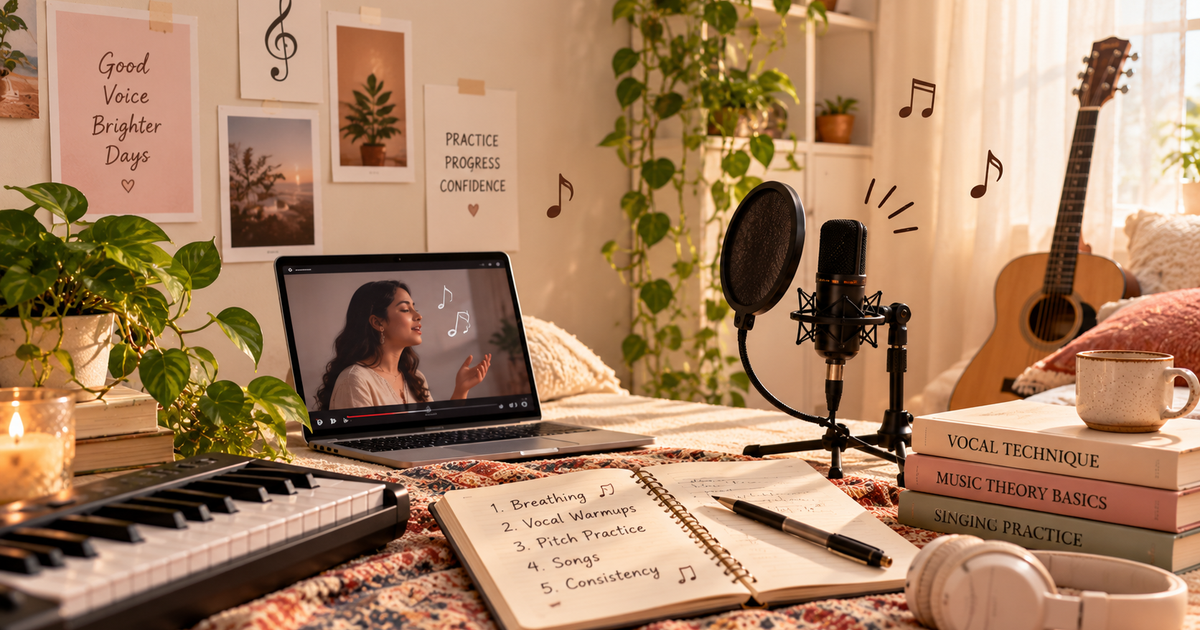
Yes, you can start learning singing at home. Beginners can work on pitch, breathing, ear training, vocal coordination and song practice without immediately joining a formal class. The challenge is knowing what to practise, how often to practise and how to tell whether you are actually improving.
That is why learning to sing is not simply about singing more songs. A structured approach makes practice more useful and helps you avoid jumping randomly between vocal exercises.
Can You Teach Yourself to Sing?
You can develop several fundamental singing skills through consistent self-practice.
A beginner can start working on:
- Pitch accuracy
- Rhythm
- Breathing
- Basic vocal coordination
- Ear training
- Pronunciation
- Vocal range awareness
- Singing simple melodies
- Song interpretation
However, self-learning has an obvious limitation: you hear your own voice differently from how other people hear it. You may also repeat the same technique incorrectly without realising it.
This is one reason beginners often turn to teachers after trying YouTube videos, apps or random vocal exercises on their own.
How Should a Beginner Start Singing?
Instead of trying to increase your vocal range immediately or imitate a professional singer, begin with the fundamentals.
1. Understand Your Natural Voice
Your voice does not need to sound like your favourite singer's voice.
Start by identifying where your voice feels comfortable. Pay attention to the notes that feel easy, the notes that become difficult and whether you are forcing your voice to reach them.
Your initial goal should be control and comfort, not simply hitting the highest note possible.
2. Work on Pitch
Pitch is one of the most important foundations of singing.
Start with simple notes and short patterns. Listen carefully, sing the note back and check whether your voice matches the pitch.
You can use a piano, keyboard or digital tuner as a reference. Over time, this helps connect what you hear with what your voice produces.
3. Develop Your Ear
Good singing is partly an ear-training skill.
Practise identifying whether a note is:
- Higher
- Lower
- The same
- Slightly sharp
- Slightly flat
This can be more useful than endlessly repeating vocal exercises without understanding what you are listening for.
4. Learn Basic Breathing and Support
Breathing is important for controlling phrases and sustaining notes, but beginners do not need to turn every singing session into an elaborate breathing workout.
Start by learning to breathe comfortably and avoid unnecessary tension. As your technique develops, you can work on breath management for longer phrases and different styles of singing.
5. Warm Up Gently
A beginner singing routine can include gentle humming, lip trills and simple pitch exercises before moving into songs. The goal of a warm-up is to prepare your voice, not to exhaust it.
If an exercise causes pain, persistent discomfort or unusual strain, stop rather than trying to push through it.
How Much Should a Beginner Practise Singing?
Consistency matters more than extremely long sessions.
A beginner can start with a short, focused practice session several times a week and gradually increase the duration as the routine becomes comfortable.
| Practice area | Example focus |
|---|---|
| Warm-up | Gentle vocal exercises |
| Pitch Matching simple notes | Ear training |
| Identifying pitch changes | Technique Basic vocal coordination |
| Songs Applying skills to repertoire | Review Recording and listening back |
A useful practice session could include:
This approach is more productive than spending an hour singing songs without deliberately working on any specific skill.
How Can You Tell If Your Singing Is Improving?
One of the simplest methods is to record yourself.
Choose a short song or exercise and record it periodically under similar conditions. Listen for:
- More accurate pitch
- Better rhythm
- Greater control
- More consistent tone
- Easier transitions between notes
- Better breath management
- Less unnecessary tension
Improvement is not always obvious from day to day. Comparing recordings over several weeks can make gradual progress easier to recognise.
Can You Learn Singing Without a Teacher?
Yes, but there is a difference between learning independently and learning without feedback.
You can use online videos, exercises and practice resources to build foundational skills. The problem is that a beginner may not know whether a particular technique is helping or creating an inefficient habit.
A teacher can listen to your voice, identify areas that need attention and adjust exercises according to your level.
This becomes particularly useful when you are working on:
- Pitch accuracy
- Breath control
- Vocal range
- Pronunciation
- Vocal technique
- Performance
- Specific musical styles
Is Singing Mostly Natural Talent?
Singing involves natural differences in voice, hearing and musical experience, but many important singing skills are trainable.
A beginner who initially struggles with pitch may improve through ear training and consistent practice. Likewise, coordination, rhythm, breath management and musical expression can develop over time.
The useful question is not:
"Was I born with a good singing voice?"
It is:
"Which singing skills do I need to develop?"
That turns singing from a vague talent test into a set of learnable skills.
Should You Learn Singing Through Songs or Exercises?
Both have a place.
Exercises help isolate specific skills. Songs teach you how to apply those skills in actual music.
For example, you might practise pitch accuracy separately and then use a familiar song to apply it. You can also select songs within a comfortable vocal range before gradually taking on more demanding material.
The goal is not to choose between exercises and songs. It is to connect them.
Can You Learn Singing Online?
Yes. Online singing lessons can be useful when they provide structured instruction and individual feedback rather than simply giving you a library of videos.
For a beginner, a live lesson can help identify problems that may be difficult to notice independently. It can also make the learning path more personalised.
Online learning can be particularly practical for students who need flexible scheduling or cannot regularly attend a physical music school.
How to Build a Simple Singing Routine at Home
If you are starting from zero, keep your routine simple:
Step 1: Warm up gently.Step 2: Practise pitch matching.Step 3: Do a short ear-training exercise.Step 4: Work on one technical skill.Step 5: Sing one or two suitable songs.Step 6: Record a short section.Step 7: Listen back and identify one thing to improve next time.
Do not try to fix everything in one session.
Choose one or two measurable goals and repeat them consistently.
Frequently Asked Questions
Build Your Singing Skills Step by Step
Learning to sing does not require you to become perfect before you start performing. Begin with the fundamentals, practise consistently, listen to your own progress and gradually expand what you can do.
For learners who want structured guidance, ChordsCraft offers personalised vocal training across Hindustani and Western singing, allowing students to develop their skills with live instruction rather than relying entirely on self-directed practice.
Related Music Courses
Classical & Modern Piano
Learn piano with graded ABRSM/Trinity curriculums from certified instructors.
Acoustic Guitar Essentials
Master chords, strumming patterns, fingerstyle, and popular song arrangements.
Ukulele for Beginners
Fun, light, and easy to learn. Perfect first instrument for kids and adults.
Flute & Woodwinds
Learn breath control, embouchure, scale structures, and classical melodies.
ChordsCraft Music Editorial Team
Start Your Musical Journey Today
Experience 1-on-1 personalized lessons with certified music and dance instructors. Pick your instrument, choose your schedule, and get structured guidance.
Recommended Reading
 General
Vocal Range: What It Is, How to Test It & Find Your Voice Type
Discover your vocal range, learn how to test your highest and lowest notes, and identify your voice type. Explore practical tips to understand your voice and improve your singing.
 General
10 Greatest Female Singers of All Time: Iconic Voices That Changed Music
From breathtaking vocals to unforgettable performances, these 10 greatest female singers of all time have shaped generations of music. Discover the unique styles and lasting influence of legendary singers from India and around the world.

 General
How to Overcome Stage Fear While Performing Music: Practical Ways to Build Performance Confidence
Stage fear can make even well-practised musicians forget lyrics, miss notes or lose confidence. Learn how to overcome stage fear while performing music with practical techniques from experienced professionals.