Vocal Range: What It Is, How to Test It & Find Your Voice Type

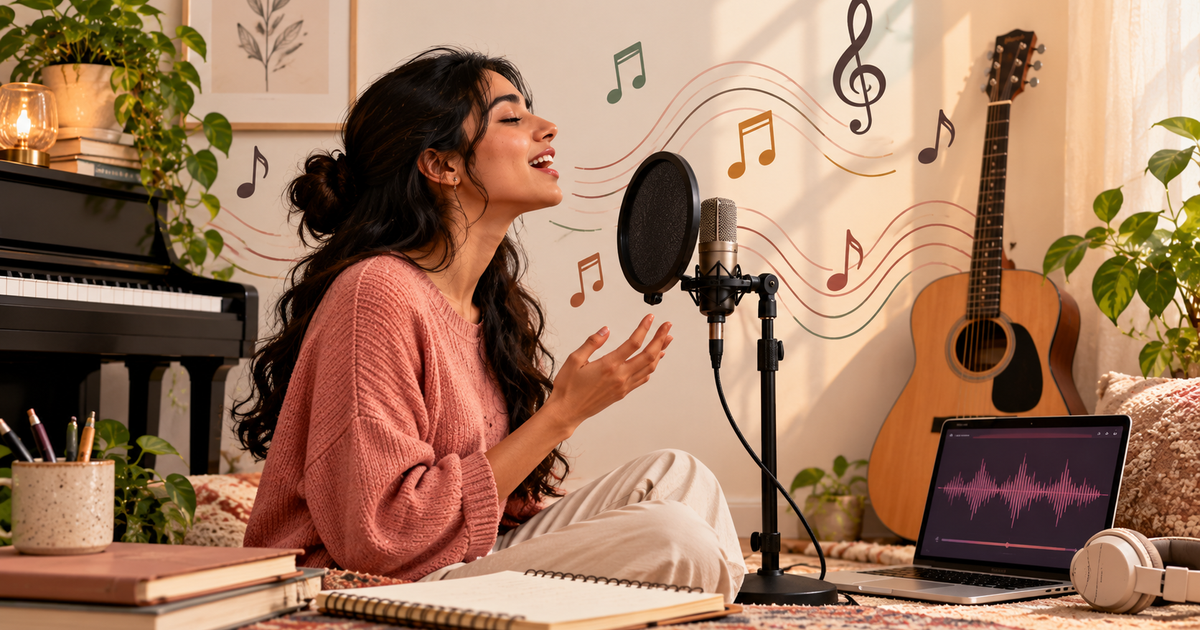
Can you sing a low F3 or reach a high C5? Your vocal range is the span between the lowest and highest notes you can sing. But knowing two notes is only the beginning. Your comfortable range, vocal tone, pitch control, and the part of your voice where you sing most easily also matter when understanding your voice.
If you are learning to sing, a vocal range test can help you discover your current range and choose songs that suit your voice. However, an online test should be treated as a starting point—not a complete diagnosis of your voice type.
What Is Vocal Range?
Vocal range is the complete span of musical notes that a person can produce with their voice, from the lowest note to the highest note.
For example, if your lowest comfortable note is G3 and your highest comfortable note is G5, your measured vocal range is G3–G5, covering two octaves.
Your range can change with training. Beginners may not initially access the full range of their voice because pitch control, breath coordination, vocal technique, and familiarity with different registers develop over time.
It is also important to distinguish between a note you can briefly force out and a note you can sing comfortably, consistently and musically.
What Is a Vocal Range Test?
A vocal range test is a tool or exercise used to identify the lowest and highest notes you can sing.
Online vocal range tests usually use your device's microphone to detect the pitch you produce. Some tools display the notes on a keyboard or give you a range such as C3-C5.
A practical test should focus on notes you can produce without excessive pushing, shouting or straining. Online tools can be useful for getting an initial measurement, but they cannot fully assess qualities such as vocal tone, resonance, comfortable singing range or technique.
Reddit discussions among singers also highlight this limitation: automated tests can sometimes register vocal fry, strained sounds or other noises as notes, which can produce misleading results.
How to Test Your Vocal Range
You can test your range with a piano, keyboard or a reliable online vocal range tool.
1. Warm up first
Do a few gentle vocal warm-ups before testing. Avoid immediately trying to reach your absolute highest or lowest note.
2. Start around your comfortable speaking or singing range
Sing a simple sustained vowel such as “ah” or “la” at a comfortable pitch.
3. Move downward gradually
Continue to lower the pitch one note at a time. Stop when the sound becomes unstable, breathy, excessively pressed or uncomfortable.
4. Move upward gradually
Repeat the process going higher. Again, don't force the last possible note just to increase the number of octaves.
5. Record your lowest and highest comfortable notes
The useful result isn't necessarily your absolute physical limit. For singing, the notes you can produce with control and a consistent tone are more meaningful.
A piano or keyboard can be particularly useful because it gives you a fixed pitch reference. You can also use a browser-based vocal range test if you don't have an instrument.
Vocal Range vs Voice Type: Are They the Same?
No. Vocal range and voice type are not the same thing.
Your vocal range describes how low and high you can sing. Voice type is a broader classification that considers factors such as:
- Vocal range
- Comfortable singing range, or tessitura
- Vocal tone and timbre
- Register transitions
- Vocal weight
- Where the voice resonates most naturally
This distinction matters because two singers can have similar ranges but very different voices.
Singers on Reddit frequently point out that voice type cannot reliably be determined from a range test alone, particularly for beginners.
So if an app tells you that you are a soprano, alto, tenor or bass, treat that result as an indication, not a definitive classification.
What Are the Main Voice Types?
| Voice Type | General Character |
|---|---|
| Soprano | Higher female voice |
| Mezzo-soprano | Middle female voice |
| Alto/Contralto | Lower female voice |
| Tenor | Higher male voice |
| Baritone | Middle male voice |
| Bass | Lower male voice |
In Western classical singing, the commonly discussed voice categories include:
These categories are useful, particularly in classical and choral contexts, but they should not be treated as rigid boxes for every singer or musical style.
For pop, Bollywood, contemporary and many other styles, what matters may be less about a classical label and more about range, tone, pitch control, style and where your voice feels strongest.
What Is Tessitura?
Tessitura is the part of a singer's range where their voice feels most comfortable and can be sustained effectively.
This is one reason your vocal range alone doesn't tell the whole story.
Imagine two singers who can both reach C5. One may sing comfortably around that area for an entire song, while the other may only reach C5 briefly. Their overall vocal capabilities are therefore different even though their measured ranges overlap.
For beginners, learning where your voice feels natural can be more useful than chasing the highest note possible.
Is a Wider Vocal Range Better?
Not necessarily.
A large vocal range can be useful, but it does not automatically make someone a better singer.
A singer with a smaller range can still have excellent:
- Pitch accuracy
- Tone
- Breath control
- Musicality
- Phrasing
- Expression
- Vocal consistency
A Reddit discussion on vocal range made the same broader point: an impressive range is not particularly useful if the notes are produced poorly or cannot be used musically.
The goal of vocal training should therefore not be simply to collect more high and low notes. It should be to develop control, coordination and a healthy, expressive voice.
Can Vocal Range Increase With Singing Training?
Yes, your usable range can develop with appropriate training.
As you learn better breath coordination, pitch control, register transitions and vocal technique, you may become able to sing notes that were previously difficult or inaccessible.
However, range development should be gradual. Repeatedly forcing extremely high or low notes can encourage unhealthy vocal habits. If a note causes pain or significant discomfort, stop rather than trying to push through it.
How Do You Find the Right Songs for Your Vocal Range?
Once you know your comfortable range, you can use it when choosing songs.
A song doesn't necessarily have to be performed in the original singer's key. Changing the key can make a song more comfortable for your voice.
For example, if a song consistently sits too high, lowering the key may allow you to sing the melody without straining. Similarly, a song that sits too low can sometimes be transposed upward.
This is especially useful for beginners because you can work on pitch and expression without constantly fighting the song's original range.
What Does Vocal Training Actually Improve?
Vocal training isn't simply about extending your range.
A structured singing programme can work on several areas, including:
- Pitch accuracy
- Breath control
- Vocal coordination
- Register development
- Tone and resonance
- Vocal flexibility
- Song interpretation
- Performance confidence
At ChordsCraft Institute of Music, vocal training includes both Hindustani and Western vocals, with a focus on voice culture, pitching, classical and pop styles, and stage coaching.
ChordsCraft also has dedicated faculty for Hindustani vocals, Western vocals and Bollywood singing, allowing learners to work with instructors across different vocal approaches.
Frequently Asked Questions About Vocal Range
Final Takeaway
Your vocal range tells you how far your voice can travel, but it doesn't tell the whole story of your singing voice.
For a more useful picture, look at your comfortable range, tessitura, tone, pitch accuracy and vocal control alongside your lowest and highest notes. A vocal range test can be a helpful first step, but learning how to use your voice well is what turns those notes into singing.
If you want structured guidance, ChordsCraft offers personalised vocal training across Hindustani, Western and Bollywood singing, with live instruction and individual feedback. You can book a free trial class to explore the learning approach before enrolling.
Related Music Courses
Classical & Modern Piano
Learn piano with graded ABRSM/Trinity curriculums from certified instructors.
Acoustic Guitar Essentials
Master chords, strumming patterns, fingerstyle, and popular song arrangements.
Violin Academy
Perfect your bow posture, tone production, classical scales, and ear training.
ChordsCraft Music Editorial Team
Start Your Musical Journey Today
Experience 1-on-1 personalized lessons with certified music and dance instructors. Pick your instrument, choose your schedule, and get structured guidance.
Recommended Reading
 General
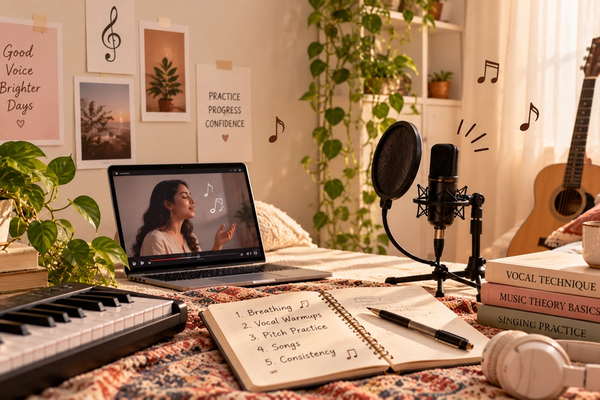
How to Learn Singing at Home: A Beginner's Step-by-Step Guide
Want to learn singing at home? Follow this beginner-friendly guide to practise vocal warm-ups, pitch, breathing, rhythm and song techniques to build confidence and improve your voice.
 General
10 Greatest Female Singers of All Time: Iconic Voices That Changed Music
From breathtaking vocals to unforgettable performances, these 10 greatest female singers of all time have shaped generations of music. Discover the unique styles and lasting influence of legendary singers from India and around the world.

 General
How to Overcome Stage Fear While Performing Music: Practical Ways to Build Performance Confidence
Stage fear can make even well-practised musicians forget lyrics, miss notes or lose confidence. Learn how to overcome stage fear while performing music with practical techniques from experienced professionals.