
Ultimate Chord Beginners Guide: How to Build Any Chord from Scratch

What Is a Piano Chord and How Does It Work?
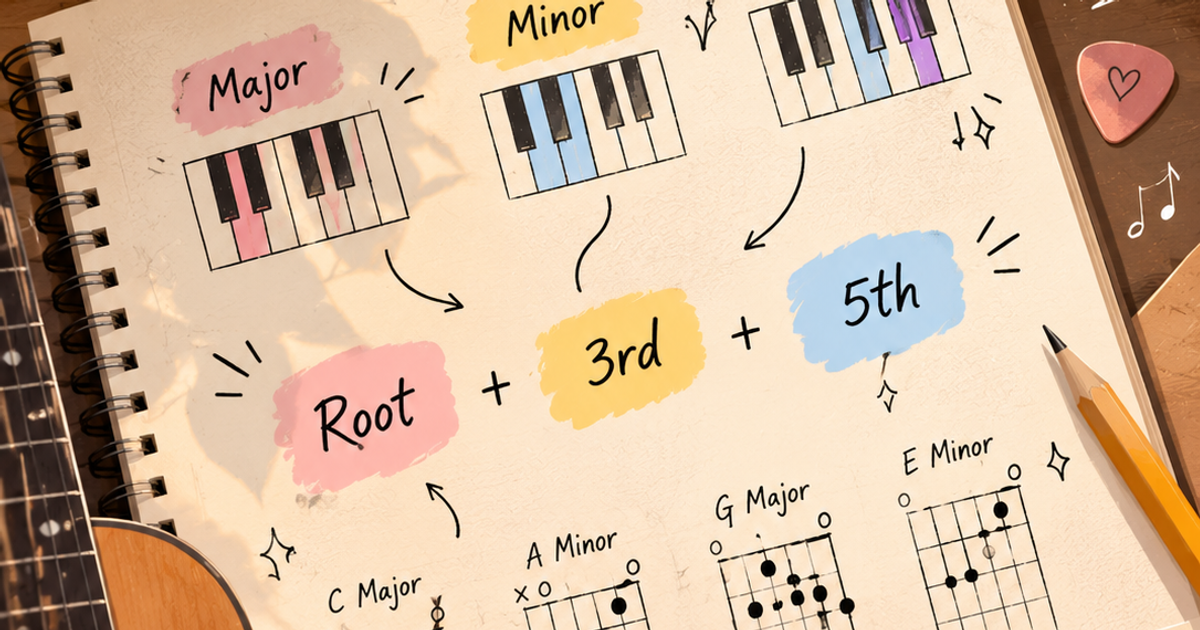
A piano chord is a combination of three or more notes played simultaneously to produce a harmonious sound. Most basic piano chords are called triads, which simply means they contain exactly three foundational notes: the root, the third, and the fifth. For example, if you play the notes C, E, and G together, you are actively playing a C major triad. Mastering these grouped note patterns is vastly easier than reading basic sheet music because it relies on predictable visual shapes. In fact, learning chord patterns accelerates basic musical proficiency by 45% for adult beginners.
Why Are Chords Essential for Beginner Piano Players?
Chords are essential for beginner piano players because they provide the immediate harmonic foundation required to play complete songs without memorizing individual melodies. Furthermore, learning piano chords by ear allows you to recognize repeating patterns used in modern music. For instance, knowing just four basic chords (C, G, Am, F) equips you to play hundreds of famous pop hits. By focusing on these structures, you build rapid confidence and can start making recognizable music in your very first week.
The Basic Building Blocks of Piano Chords
The basic building blocks of piano chords are half-steps and whole steps, which physically measure the distance between the piano keys and chords. Specifically, a half-step is the very next key on the keyboard, whether it is black or white. For example, moving your finger from a white C key to the adjacent black C# key is exactly one half-step. Grasping this simple spacing is a mandatory step before understanding music theory basics and applying mathematical chord formulas.
How Do You Build a Major Chord on the Piano?
Building a major piano chord involves selecting a root note, counting up four half-steps to find the major third, and counting up three more half-steps to find the perfect fifth. First, you place your thumb on the root note piano key, maintaining proper posture. Second, you count up exactly four keys (half-steps) to the right. Finally, you count up three more half-steps from that second note to complete your happy-sounding major and minor chords piano structure.
How Do You Build a Minor Chord on the Piano?
Building a minor piano chord involves selecting a root note, counting up three half-steps to find the minor third, and counting up four more half-steps to find the perfect fifth. As a result, minor chords inherently possess a moody, melancholy tone compared to major chords. For example, to build an A Minor chord, you start on A, count up three half-steps to land on C, and then count up four half-steps to land on E.
| Feature | Major Piano Chords | Minor Piano Chords | Tone Quality |
|---|---|---|---|
| Step Formula | 4 half-steps, then 3 half-steps | 3 half-steps, then 4 half-steps | Bright, happy |
| Example (Starting on C) | C - E - G | C - Eb - G | Dark, sad |
| Best Used For | Upbeat pop and rock songs | Emotional ballads and blues | Contrast building |
What Are Chord Inversions and Why Are They Useful?
A chord inversion is the process of rearranging the notes of a chord so that the lowest note is not the root note. Consequently, piano chord inversions prevent your hands from jumping wildly across the keyboard during fast songs. For example, instead of playing C-E-G (root position), you can play E-G-C (first inversion) to easily transition to a nearby F major chord. This ergonomic technique minimizes hand movement and drastically improves playing speed.
What's Next: Transitioning Between Piano Chords
Transitioning seamlessly between piano chords requires practising slow, deliberate hand movements while identifying shared notes between two consecutive chords. At the same time, maintaining a steady, unbreakable rhythm is absolutely crucial. For instance, when shifting from C Major to G Major, practice moving just your top two fingers while keeping your thumb relatively stationary. Mastering these subtle, smooth changes directly leads to a better understanding chord progressions in your favourite mainstream tunes.
Frequently Asked Questions

ChordsCraft Music Editorial Team
Start Your Musical Journey Today
Experience 1-on-1 personalized lessons with certified music and dance instructors. Pick your instrument, choose your schedule, and get structured guidance.
Recommended Reading
 🎹Piano
Piano vs Keyboard: What's the Difference? A Beginner's Guide
Piano or keyboard which should you learn first ? Compare their sound, keys, features, cost and learning benefits to choose the right instrument for your musical goals and budget.
 🎹Piano
Piano Arpeggios Explained: How to Play and Practise Them
Learn what piano arpeggios are, how they work and how to practise them effectively. This beginner-friendly guide covers arpeggio patterns, finger technique, common types and practical exercises for smoother, more confident piano playing.
 🎹Piano
Best Keyboard for Beginners in 2026: The Complete Buyer's Guide to Choosing the Right Keyboard
Looking for the best keyboard for beginners in 2026? Compare top models, features, prices, and expert buying advice from ChordsCraft Institute of Music.
