Piano Arpeggios Explained: How to Play and Practise Them

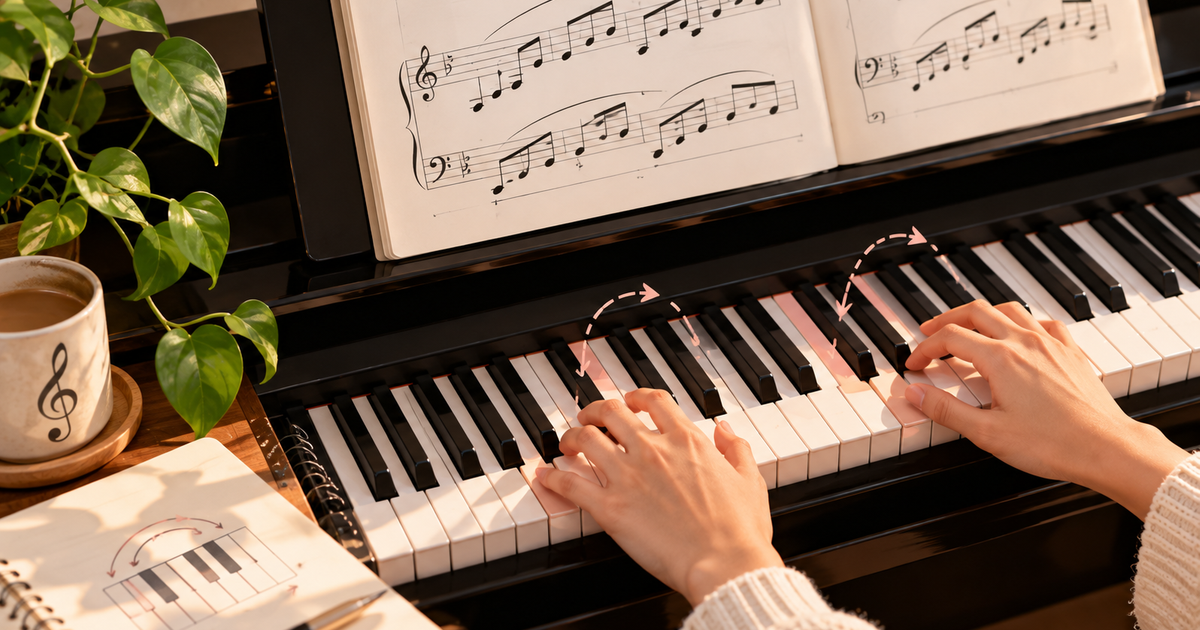
Piano arpeggios can make even a simple chord progression sound more flowing and expressive. But for beginners, they can also feel awkward at first, especially when the thumb has to move across the keyboard. The good news is that arpeggios become much easier once you understand the chord pattern, use consistent fingering and practise slowly.
Whether you're learning piano in India, taking online piano lessons in the USA, or preparing for a graded music examination, understanding arpeggios can strengthen both your technique and musical awareness.
What Is an Arpeggio on Piano?
An arpeggio is a chord played one note at a time instead of all at once. For example, a C major chord contains C, E and G. If you play those notes individually as C–E–G–C, you are playing a C major arpeggio.
Arpeggios can move upwards, downwards or follow a repeating pattern. Once you become comfortable with simple triads, you can extend them across multiple octaves.
The word arpeggio comes from the Italian arpeggiare, meaning “to play upon a harp.” This reflects the flowing sound created when the notes of a chord are played separately.
Why Are Piano Arpeggios Important?
Arpeggios are useful because they develop several skills at the same time. Regular practice can improve finger coordination, hand independence, chord awareness, rhythm and movement across the keyboard.
They are also widely used in actual music. Classical compositions, film music and modern pop arrangements often use arpeggiated patterns to create movement and texture. Instead of playing a chord as three notes together, an arpeggio allows those same notes to create a continuous musical flow.
For students following structured piano programmes, arpeggios can also form part of technical training and graded examination preparation.
What Is the Difference Between a Scale, Chord and Arpeggio?
| Musical concept | How the notes are played | Example |
|---|---|---|
| Scale | Notes move step-by-step | C–D–E–F–G |
| Chord | Notes are played together | C–E–G |
| Arpeggio | Chord notes are played individually | C–E–G–C |
| Broken chord | Chord notes are separated into a pattern | C–G–E–G |
A scale, chord and arpeggio all use musical notes, but they organise those notes differently.
An easy way to remember it is: a scale moves through notes step-by-step, a chord plays notes together, and an arpeggio breaks a chord into individual notes.
How Do You Play a C Major Arpeggio on Piano?
C major is a good starting point for beginners because its basic notes—C, E and G—are all white keys.
For a one-octave C major arpeggio, you play:
C–E–G–C
The fingering depends on the hand and the specific exercise. Your teacher or examination syllabus may prescribe a particular fingering, so it is important to learn one consistent pattern rather than changing fingers randomly.
As you practise, focus less on speed and more on making every note sound even and controlled.
Which Fingers Should You Use for Piano Arpeggios?
Fingering is one of the most important parts of learning arpeggios. Beginners often try to stretch their fingers or use the same fingering for every key, which can make the movement uncomfortable.
Instead, learn the recommended fingering for each arpeggio and practise it slowly until the movement becomes familiar. Keep your fingers relaxed and allow your hand to move naturally rather than forcing your fingers to reach distant keys. The fingering will also change depending on whether the arpeggio begins on a white or black key, so avoid assuming that one pattern works for every chord.
How Do You Move Your Thumb When Playing Arpeggios?
Thumb movement is often what makes arpeggios feel difficult initially. The aim isn't to force the thumb underneath the hand. Instead, allow the hand and forearm to move smoothly toward the next position.
Prepare the thumb for its next note before you actually need to play it. Keeping the wrist flexible also helps prevent unnecessary tension.
If your hand feels stiff while playing, slow the exercise down. Smooth movement is more important than speed, and building that control gradually will make faster arpeggios much easier later.
How Should Beginners Practise Piano Arpeggios?
Start with a simple major arpeggio and practise one hand at a time. This allows you to concentrate on fingering and movement without worrying about coordinating both hands simultaneously.
Use a metronome at a comfortable tempo and aim for an even rhythm. Once you can play the pattern accurately without tension, increase the speed gradually. If your notes become uneven or your hand starts tightening, return to a slower tempo.
You can also practise the pattern with different articulations. Controlled staccato practice can help improve accuracy, while legato practice helps develop a smoother musical sound.
Why Do My Piano Arpeggios Sound Uneven?
Uneven arpeggios are usually caused by inconsistent fingering, rushing or excessive tension. Thumb movement can also interrupt the rhythm if it happens too late.
A few things to check:
- Are you using the same fingering each time?
- Are you practising slowly enough?
- Is your wrist flexible?
- Are you preparing the thumb before its next note?
- Are you trying to increase speed too quickly?
Don't force large stretches. Let the hand and arm participate in the movement instead of making the fingers do all the work.
Can Arpeggios Be Used in Songs?
Absolutely. Arpeggios are not just technical exercises. They can be used to create accompaniment patterns, introductions, endings and flowing chord progressions.
For example, instead of playing a C major chord as C–E–G simultaneously, you can play C–E–G–E as a repeating pattern. This creates movement while keeping the same underlying harmony.
This is particularly useful when learning pop, film and contemporary piano arrangements because a simple chord progression can become much more musical through different arpeggio patterns.
What Should You Practise After Basic Arpeggios?
Once you are comfortable with simple one-octave arpeggios, you can gradually move to two-octave patterns, major and minor arpeggios, chord inversions and seventh-chord arpeggios.
You don't need to master everything immediately. Building accuracy in a few keys first gives you a stronger foundation for expanding into more difficult patterns and different keys.
For learners preparing for structured piano examinations, practising the required arpeggios alongside scales and other technical exercises can also help create a more balanced practice routine.
Frequently Asked Questions (Arpeggios)
Build Your Piano Technique with Consistent Practice
Piano arpeggios become much less intimidating when you stop treating them as speed exercises and focus instead on correct fingering, relaxed movement, even rhythm and gradual progression.
Whether you're learning independently or working with a teacher, consistent practice can help you move from simple one-octave patterns to more advanced arpeggios across the keyboard.
For personalised guidance, ChordsCraft Institute of Music offers live 1-on-1 piano lessons designed around the learner's level, goals and pace.
Related Music Courses
Classical & Modern Piano
Learn piano with graded ABRSM/Trinity curriculums from certified instructors.

ChordsCraft Music Editorial Team
Start Your Musical Journey Today
Experience 1-on-1 personalized lessons with certified music and dance instructors. Pick your instrument, choose your schedule, and get structured guidance.
Recommended Reading
 🎹Piano
Piano vs Keyboard: What's the Difference? A Beginner's Guide
Piano or keyboard which should you learn first ? Compare their sound, keys, features, cost and learning benefits to choose the right instrument for your musical goals and budget.
 🎹Piano
Piano Scales Explained: The Comprehensive Guide for Beginners
Learn piano scales from the ground up with this beginner-friendly guide. Discover major and minor scales, how scales work, why they matter, and how practising them can improve your piano technique and music theory.
 🎹Piano
Best Keyboard for Beginners in 2026: The Complete Buyer's Guide to Choosing the Right Keyboard
Looking for the best keyboard for beginners in 2026? Compare top models, features, prices, and expert buying advice from ChordsCraft Institute of Music.
