
Major vs Minor Chords on Piano: The Comprehensive Guide to the Difference

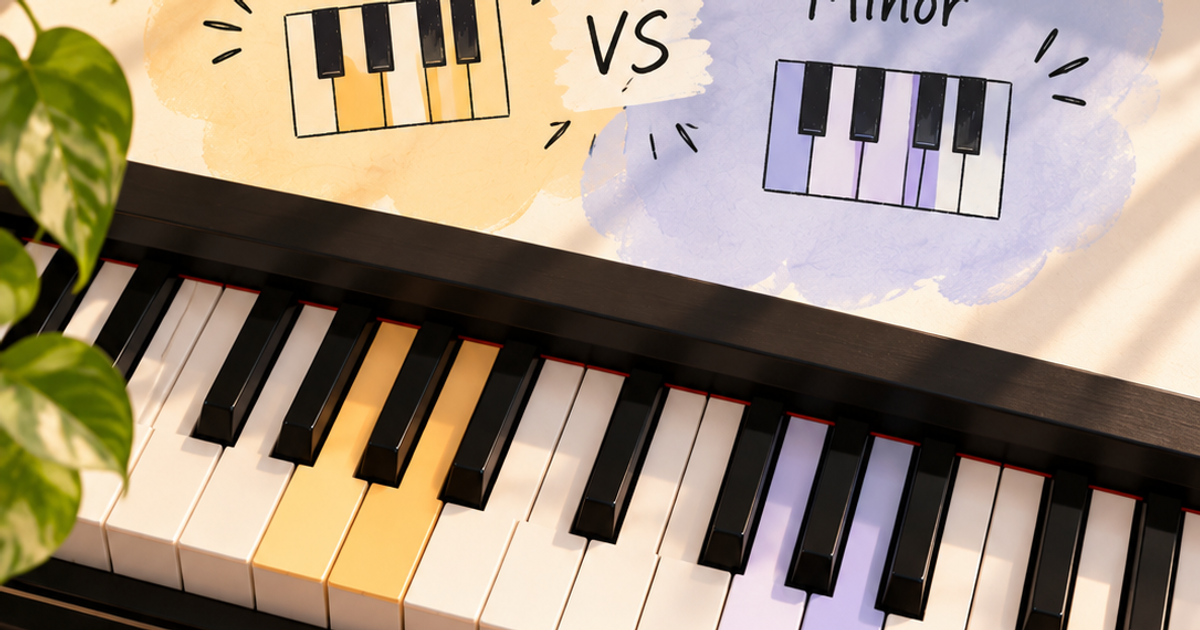
You likely already know that pressing a few piano keys at the same time creates a chord. But without understanding the specific formulas behind those keys, playing by ear or writing your own music can feel like a frustrating guessing game. In this guide, you will learn the exact formulas for building major and minor chords, how they differ in sound, and how to instantly switch between them on the keyboard.
What is a Piano Triad?
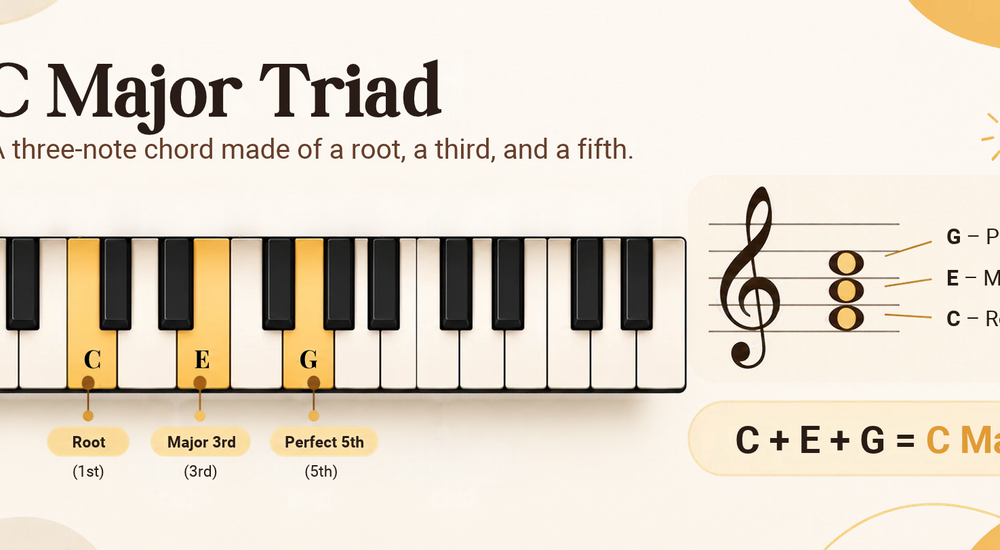
A piano triad is a fundamental three-note chord consisting of a root note, a third interval, and a fifth interval played simultaneously. These foundational blocks form the harmony in nearly all Western music. For example, playing C, E, and G together creates a basic C major triad. To fully grasp this concept, you need a solid understanding of basic piano intervals. For more details, read our guide on basic piano intervals.
Why Understanding the Difference Between Major and Minor Chords Matters for Playing Piano
Understanding the difference between major and minor chords matters because it allows you to control the emotional mood of a song, transpose music easily, and break free from relying solely on rote memorization.
What is the Formula for a Major Chord on the Piano?
A major chord on the piano is a three-note triad built using a root note, a major third (four half-steps above the root), and a perfect fifth (seven half-steps above the root). This structural pattern is widely known as the 4+3 formula. For example, if you build a C Major chord, you start on C, count up four half-steps to E, and then count up three more half-steps to G.
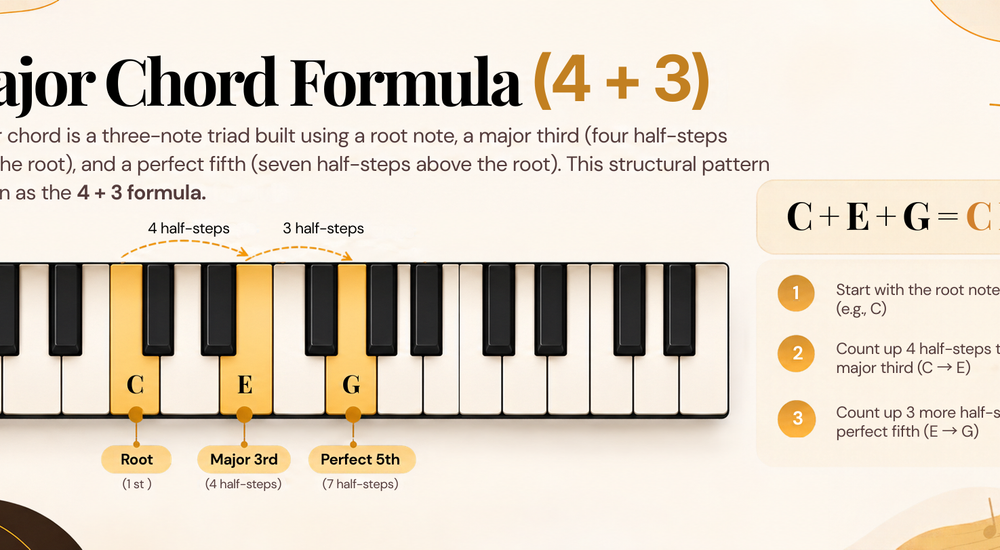
As such, learning this formula allows you to build a major chord starting on literally any key. Practicing the C major scale is an excellent way to internalize this bright sound in your daily routine. Check out our C major scale breakdown for exercises.
What is the Formula for a Minor Chord on the Piano?
A minor chord on the piano is a three-note triad consisting of a root note, a minor third (three half-steps above the root), and a perfect fifth (seven half-steps above the root). Conversely, this is recognized as the 3+4 formula. For example, playing an A Minor chord means starting on A, counting up three half-steps to C, and then four more half-steps to E.
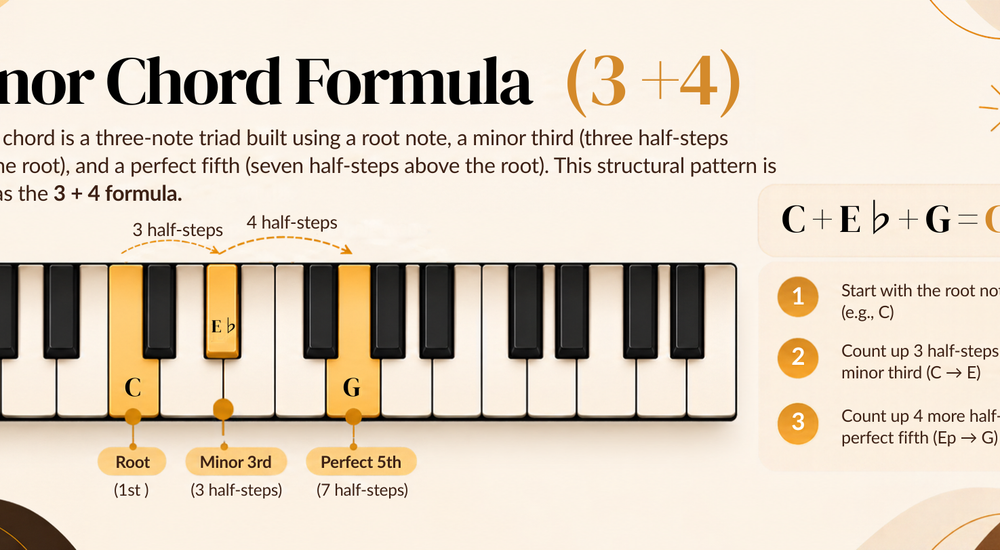
Additionally, exploring the A minor scale will help you hear how minor chords naturally resolve within a musical phrase. You can learn more by visiting our guide on the A minor scale.
Major vs Minor Chords: Side-by-Side Comparison
The primary difference between major and minor chords is the distance between the root note and the third note, which dictates whether the chord sounds bright and happy or dark and sad. Let's explore how these two foundational chord types stack up against each other in the table below.
| Feature | Major Chords | Minor Chords |
|---|---|---|
| Formula (Half-steps) | 4 + 3 | 3 + 4 |
| Middle Note (Third) | Major Third | Minor Third |
| Emotional Tone | Happy, bright, triumphant | Sad, moody, somber |
| Example (Root C) | C - E - G | C - Eb - G |
How Can I Convert a Major Chord into a Minor Chord?
Converting a major piano chord into a minor chord involves lowering the middle note, or the third interval, by one single half-step to the left on the keyboard. You do not need to change the root or the fifth notes at all. As a practical example, to change C Major (C-E-G) to C Minor (C-Eb-G), you simply move your middle finger from E down to E-flat. Mastering this quick transition requires practicing counting half-steps on the keyboard. Review our lesson on counting half-steps on the keyboard to speed up your finger memory.
Why Do Major Chords Sound Happy and Minor Chords Sound Sad?
Major chords sound happy and minor chords sound sad because of how the acoustic frequencies of their specific intervals interact with human psychology. Research indicates that roughly 85% of listeners naturally associate the wider major third interval with positive, stable emotions. At the same time, the closer, slightly dissonant minor third triggers a melancholy or introspective response.
How Do Major and Minor Chords Work Together in a Key?
Great music relies on a balanced mixture of both chord types to tell a compelling emotional story. For instance, common chord progressions frequently blend major and minor chords to create a satisfying cycle of tension and release. You can practice this concept with our list of common chord progressions. Plus, when writing your first song on piano, alternating between these major and minor sounds instantly adds dynamic depth to your composition. Discover more tips in our writing your first song on piano tutorial.
Where Should Beginners Start Practicing Piano Chords?
Beginners should start practicing piano chords by memorizing shapes in the key of C Major using a visual chord chart and a steady tempo. First, we recommend downloading a free printable piano chord chart to keep above your keyboard for quick reference. Access yours at our free printable piano chord chart resource page. Second, implementing metronome practice routines will ensure your chord transitions remain smooth and perfectly timed. Learn how to set this up in our guide to metronome practice routines.
What Are the Best Fingerings for Major and Minor Piano Chords?
To construct a standard triad in root position, both hands utilize a consistent 1-3-5 finger span (thumb, middle, pinky). For the right hand, this fingering is explicitly 1-3-5, while for the left hand, it is the mirrored equivalent, 5-3-1. For example, maintaining a relaxed hand in this natural 1-3-5 shape allows you to glide effortlessly up and down the white keys to play both major and minor chords without requiring any tension or wrist twisting.
The Game Changer : Expanding Beyond Basic Triads
The next step after mastering major and minor triads is learning diminished and augmented chords to add complex, cinematic tension to your playing. Once you are entirely comfortable with the 4+3 and 3+4 formulas, you can easily grasp diminished (3+3) and augmented (4+4) formulas. Dive into these colorful sounds in our diminished and augmented chords advanced guide.
Conclusion: The Harmony of Major and Minor Sounds
Ultimately, major and minor chords complement each other perfectly to create balanced, emotionally resonant music. By memorizing the simple formulas outlined above, you can decode almost any song by ear and begin improvising your own melodies. Start by picking one favorite song today, identifying its major and minor triads, and practicing the transitions!
Related Music Courses
Classical & Modern Piano
Learn piano with graded ABRSM/Trinity curriculums from certified instructors.

ChordsCraft Music Editorial Team
Start Your Musical Journey Today
Experience 1-on-1 personalized lessons with certified music and dance instructors. Pick your instrument, choose your schedule, and get structured guidance.
Recommended Reading
 🎹Piano
Piano vs Keyboard: What's the Difference? A Beginner's Guide
Piano or keyboard which should you learn first ? Compare their sound, keys, features, cost and learning benefits to choose the right instrument for your musical goals and budget.
 🎹Piano
Piano Arpeggios Explained: How to Play and Practise Them
Learn what piano arpeggios are, how they work and how to practise them effectively. This beginner-friendly guide covers arpeggio patterns, finger technique, common types and practical exercises for smoother, more confident piano playing.
 🎹Piano
Best Keyboard for Beginners in 2026: The Complete Buyer's Guide to Choosing the Right Keyboard
Looking for the best keyboard for beginners in 2026? Compare top models, features, prices, and expert buying advice from ChordsCraft Institute of Music.
